Description
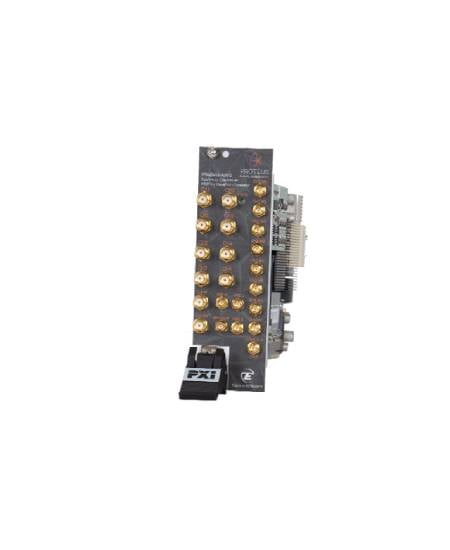
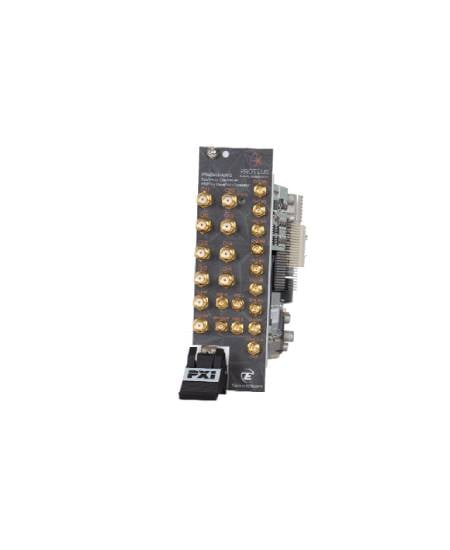
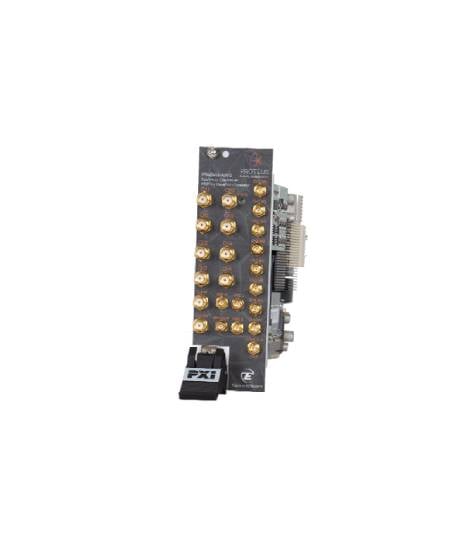
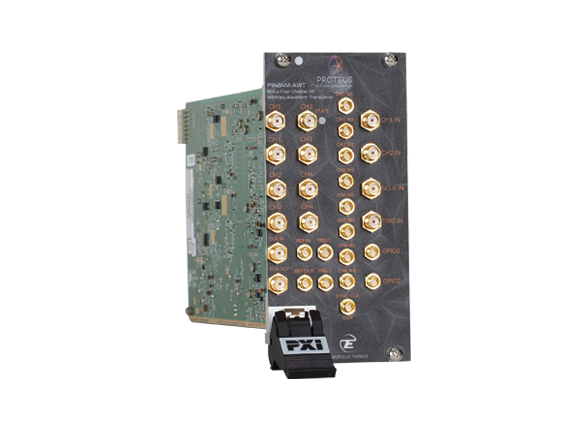
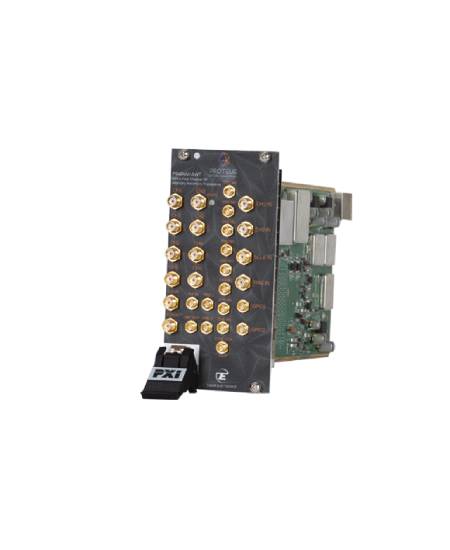
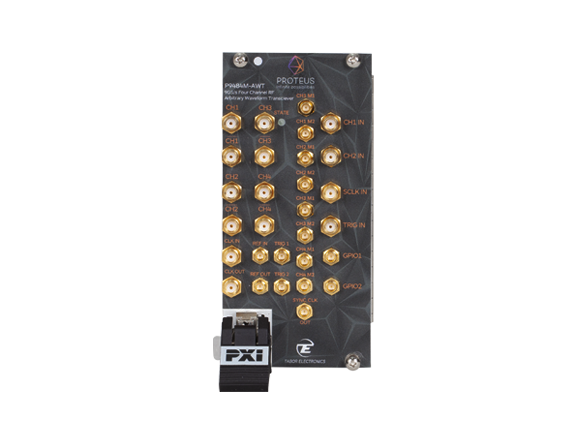
P2582M Proteus AWG for High Speed RF Applications
The Tabor P2582M Proteus AWG is engineered for professionals who require both speed and intelligence in waveform generation. Built on advanced SDR architecture, it does more than generate signals. It listens, processes, and reacts in real time, making it ideal for Electronic Warfare simulation, radar system development, next generation wireless testing, and quantum control experiments.
With a 2.5GS/s sample rate and 16-bit vertical resolution, the P2582M Proteus AWG ensures high fidelity waveform output with exceptional dynamic range. The standard 1GS onboard memory supports long and complex waveform sequences, while optional upgrades allow expansion up to 16GS. This capacity enables continuous streaming of dense, non-repeating threat environments and large real-world datasets required for modern RF validation.
Modular and Scalable Architecture
The P2582M Proteus AWG is built on the PXI Express platform, offering a compact and scalable design. It integrates seamlessly into multi-channel systems that can expand from a few channels to hundreds in a synchronized chassis. Its architecture supports phase-coherent operation, which is critical for massive MIMO research, radar testing, and multi-qubit control setups.
The fast PCIe backplane ensures ultra-high data throughput. Engineers can transfer waveform data bidirectionally, stream signals in real time, and remove traditional memory bottlenecks that limit performance.
Real-Time Feedback and Adaptive Control
One of the strongest advantages of the P2582M Proteus AWG is its integrated FPGA-based feedback control system. By combining DAC output and optional ADC input within the same hardware environment, the system eliminates PC round-trip delays. This allows conditional waveform generation, meaning the output signal can instantly change based on incoming measurements.
For closed-loop Electronic Warfare systems, radar target simulators, and qubit reset operations, this real-time responsiveness dramatically improves realism and system efficiency.
Task Driven Sequencing
The Task Table engine functions as a conditional state machine rather than a simple linear sequencer. It enables intelligent jumps between waveform segments based on triggers or logic conditions. In radar mode, the instrument can detect pulses and immediately generate modified echoes such as delayed or Doppler-shifted signals to simulate moving targets.
Programming is straightforward using Python, MATLAB, C, LabVIEW, and SCPI commands, ensuring smooth integration into research labs and automated production systems.
Technical Specifications
| Parameter | Specification |
| Model | P2582M |
| Instrument Type | Arbitrary Waveform Generator |
| Sample Rate | 2.5GS/s |
| Vertical Resolution | 16-bit |
| Standard Memory | 1GS |
| Maximum Memory | Up to 16GS |
| Channels | 2 |
| Markers | 8 |
| Architecture | PXI Express |
| Data Interface | High-speed PCIe |
| Optional Digitizer | 5.4GS/s single, 2.7GS/s dual channel |
| Streaming Capability | Up to 6GS/s optional |
| Trigger Input | 10MHz standard, 50MHz optional |
| FPGA Programming | DSP blocks and open core options |
| Programming Interfaces | SCPI, Python, MATLAB, C, LabVIEW |
Click here to learn more about similar products from Tabor Electronics Ltd.